Wednesday, 13 July 2011

IN3D Wk 12

1)  Do you need to be able to draw well to create good 2D animation? Explain your view.

   We do not need to be able to draw well to create a good 2D animation. 2D is quite simple to draw because it does not require much details of an object. It is just drawing the surface of an object.


2) Do you need to be able to draw well to create good 3D animation? Explain your view.

   We do not need to be able to draw well to create good 3D animation but we need to be able to visualize the dimension of depth, width and height of the object or character. When we know how to see the object from a perspective view, we can see the detailed parts such as how tall or short is the object, how thin or thick is the object, etc. From there, we can draw out the proportionate shape of it.


3) What do you think would separate a piece of poor animation from a piece of good animation? In other words, how would you go about deciding if a piece of animation is good or bad?

    I think one of the things that separates a poor animation from a good animation would be the lacking of principles of animation. An example for a poor animation would be like a character walking aimlessly without any expressions, and no different types of actions to impress the audience. An example of a good animation is a character exaggerating their actions at a specific time. For instance, the character receives a huge present from someone. When he/she sees the present, they expressions would be excited, eyes and mouth opened wide, etc. These little details will affect the audience as it tells them how to react.


4) In 2D animation, you need to be very aware of timing at a frame by frame level, using timing charts and other techniques - but for 3D animation, this is handled using the graph editor, which is more concerned with manipulating rates of change over time.

Does this affect how you approach your animation work? Explain.

It does not affect how I approach my animation work. Both 2D and 3D animation require us to take note of the timing. It does not matter which method is better to use. For 2D, we use techniques like key frames to take note of the timing for animation. For 3D, we use the graph editor to take note of the timing by adjusting the gradient or points of the graph.


5) Give a brief critique of Maya as an animation tool. Don't just say Maya makes animation difficult, or easy, or that you need to learn a lot of stuff to use Maya - explain what Maya does well and not so well in terms of creating animation.

    Overall, I find that Maya can do animation similarly to Flash. We can use Maya to create effects of an object, control the animation timing, 3D textures and shadings, etc. We can also use polygons to create a character and position them at the right place by using the 4 different panels.

Tuesday, 12 July 2011

IN3D Wk 11 Elearning

Squash and Stretch Animation


Why is squash and stretch so useful in animation?

It is useful in animation because this is to give the drawn objects a sense of weight and flexibility. It also creates a comical effect to the character.


Think of a situation in which extreme squash and stretch could be applied to a character - try to be original.

An example is a sponge. A sponge is being squashed when a person use force to squeeze it. It also can be stretched when the person tries to make it longer.


Think of an animation example where squash and stretch would NOT be appropriate.

Squash and stretch could not be applied to real life humans and animals. Our bodies are not flexible enough to add the effect. Unlike animation, we can use a software like flash and Maya to change the flexibility of the character.


If squash and stretch doesn't really happen so obviously in real life, why do you think is it so effective in animation?
 (Look at the title of Disney animator Ollie Johnston's famous book about animation - do an Amazon search ... there's a clue in the title!)
One of the famous book about animation by Ollie Johnston is The Illusion of Life. It was also written by Frank Thomas. Inside the book, they had included the 12 basic principles of animation. Squash and stretch is the most important principle. It gives the drawn objects a sense of weight and flexibility. This can be applied to objects or even human faces. A figure can have a comical effect if it is squashed or stretched to an exaggerated degree. The purpose of using squash and stretch is related to the laws of physics - based on observations of physical behaviour. Given from the book title "Illusion" means visual stimuli, which represents what is perceived in a way different from the way it is in reality. Therefore, when "squash and stretch" is applied in animation, the character turns out to be even funnier whereas in real life, we can't possibly squash and stretch a person because we are not objects.

Thursday, 30 June 2011

IN3D Week 10 Lab 1

    Principles of Animation


    Staging
    There are 2 people standing at a distance away. This is to tell the audience clearly that they are throwing the wallet to each other.

    Anticipation

    As we can see from the video, that the girl on the left is anticipating to throw the wallet to the opposite party. This is to show the preparation of an action that will be done.

    The girl in the video above shows that she is getting ready to jump.

    Exaggeration
    The person is trying to run in a normal way, but at the same time she is trying to exaggerate by expressing her emotions while she is running. 

    Timing
    This is a slow motion run.  Speed affects the timing. It also means that the person can change his/her actions when they are doing a specific task.

    Straight Ahead Action and Pose to Pose
    This action is fast moving. The action is being planned out and it starts from the beginning to the end.


    Ball Animation


    What is ease-in-ease-out in reference to animation?

    Ease-in-ease-out is also known as slow in and slow out. Animation looks more realistic if it has more frames near the beginning and the end of a movement, and fewer in the middle. This principle is being used for characters moving between 2 extreme poses, such as sitting down and standing up. It is also used for in-animation moving objects such as bouncing ball.

    What does frames per second mean?
    It means the number of image frames being shown within one second. This is used for the measurement of a video clip.


    This is an example of ease-in-ease-out.

    Saturday, 21 May 2011

    IN3D Project 1 - Part 1

    Story

    The story is about a drum pad which happened to roll down the tracks while the train is still on the move. A train travels from station to station. While the train was happily moving along, suddenly, the train was vibrating vigorously. The train could not stop on time although it was moving as fast as it could. Unfortunately, there were blocks blocking the way and the train crashed into the blocks and was hit by the drum pad.


    Shape of Drum Pad

    Amount and Type of Surface Details: 
    - The center of the drum pad where we used to hit on, is a little bit rough.
    - As for the rim surrounding the drum pad, its texture is smooth.
    - There are also bumps at the bottom of the drum pad.

    Number and Type of Primitive Parts:
    - The drum pad is mostly made up of cylindrical shapes.
    - At the bottom of it, there are rectangles and a hexagon.

    Technical Aspects to be used:
    - Extrusion: For the rim and the bottom part of the drum pad.
    - Beveling: For the whole drum pad.
    - Booleans > Difference: To create the hole for the ring and the screws.


    Wire frame Sketches

    Top View

    Bottom View


    Design of Original Drum Pad

    Top View

    Bottom View

    Side View


    Research - A Snare Drum which is similar to the Drum Pad


    Side View


    Bottom View


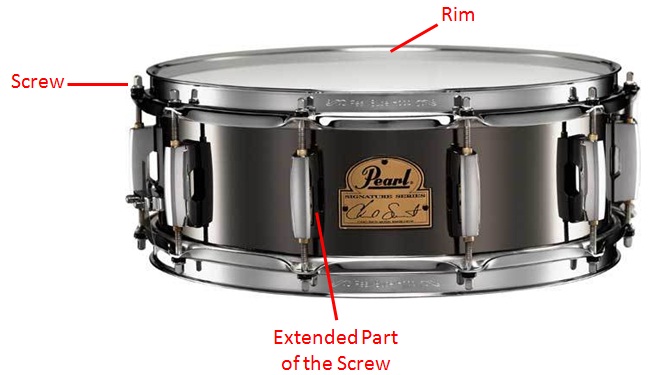
    This is a snare drum which is similar to my final object in a certain way. It is cylindrical in shape just like the drum pad. The snare drum has screws that are extended at the side around the rim, while the drum pad also has screws surrounding the rim. One thing that is different about the drum pad and the snare drum is their parts at the bottom. The drum pad has 8 extruded lines, an extruded ring, a rubber surrounding it, and a hexagon-shaped screw, while the snare drum has a smooth surface with a metal chain in the middle.


    Self-Critique - Final Model


    Top View


    Maya

    Original

    Side View


    Bottom View


    Maya

    Original


    Success of my Final Model:

    Extrusion Method - My first conception was doing the extruded part for the bottom part of the drum pad and the rim at the top of the drum pad. I used to think that the extrusion method was needed. However, I did not use that extrusion method because I did not know how to select the vertices since the drum pad was a cylindrical shape. Therefore, I managed to use the rectangle polygon to make the extruded lines.

    Beveling Method - I did bevel most of the parts of the drum pad such as the rim, the screws, and extruded lines at the bottom.

    Booleans > Difference Method -  For the screws surrounding the rim and the hexagon screw, I used booleans > difference to create empty space in the middle of the polygon shape.


    Errors Made:

    With reference made from the original picture of the drum pad, as we can see there are a total of 8 screws from the top view, and there are 8 extruded lines at the bottom. However, in my final model, there are only 7 screws at the top of the drum pad, and 7 extruded lines at the bottom.

    Another error is the smooth part of the drum pad which is those parts that are made of cylindrical polygons like the rubber at the bottom, the ring and the surface of the drum pad. They are meant to be smooth but somehow I do not know why it cannot be smoothen out when I select the edges. They just seem to be out of shape. I can still see the cylindrical polygons are not as smooth as the original.

    Lastly, I was supposed to use the extrusion method for the extruded lines (at the bottom) and the rim (at the top) of the drum pad. I do not know how to extrude them because it was a cylindrical shape. When I select the faces that I want to extrude, the whole part of it will extrude instead of just extruding a single line. Therefore, I decided to use the polygon to create the extruded parts.

    Tuesday, 17 May 2011

    Week 4 E-learning

    - Does multi-tasking give you a real or false sense of having accomplished something?

    From my point of view, multi-tasking may or may not work for me to accomplish something. 

    Advantage:

    Whenever I have homework to do, I usually do what I can first. Then I will sign in to MSN to see if my friends are online so that I could ask them about anything if I'm having problems with any work. Usually, I will put my status as"busy", and then continue with my homework so that people know that I'm busy doing something and that I may not reply their online messages. This allows me to do my work without distractions.

    Disadvantage:

    If I have a project to do, or if there are lots of homework to be done, I cannot sign in to MSN because I cannot focus on what I am doing. It will take me a longer time to accomplish my work when most of the time I have been chatting online with my friends.


    - Is learning 3D and design different from learning programming, or is all learning the same? Why?

    Learning 3D and design compared with learning programming, I feel that they are not related. 3D and design is about designing objects by looking at them from a perspective point of view. It requires creativity and understanding of the objects' property - like how they should look like. For programming, it means that you are using technologies or software applications to make something work. It is often accomplished by using hard-coding. All learning may or may not be the same, depends on how individual apply the method used for their own learning.


    Thinking Outside the Traditional 3D Mindset


    Extracts from “Thinking Outside the Traditional 3D Mindset“ by Pete Bandstra.


    The access to education resources in today’s web driven world continues to grow with each passing day.

    Today’s students are connected to each other through laptops and phones, social networks and other technologies to keep them up to date on what is believed to be important to their lives.

    While in lecture, using a laptop to take notes, they will IM with someone in the room or across the country, watch a video, and play a game or check their facebook stats. By taking a short, survey of a class the students learned a great deal about the time they waste with non-productive events.

    Although the debate continues on the topic of multitasking and if the distractions have any true benefit for students, research studies continue to prove that; listening to an iPod, text messaging, watching videos and doing homework at the same time does not work and the only benefit is a heightened sense of distraction.

    Learning is actually a very complex operation for an individual.


    - The article states that “Learning is actually a very complex operation for an individual”. Do you agree with this? Do you feel that you approach your learning in the best way – if yes, how, and if no, how can you change your work style?

    Yes, I agree with the statement above. Teenagers nowadays tend to on their computers or laptops often because they feel that they can do their work better. Students like me have a couple of modules or subjects to take. Most of the subjects have their own difficulties in some way. If I do not understand what I am learning, I will not know how to start my homework or how I should study this subject. When someone asks me a question regarding any subjects, I do not know how to give them an answer. Sometimes, there is a need for us to go online to search for resources for our own learning.

    I feel that I do not really approach my learning in the best way. I only study when exams are near. I should try to get used to the habit of revising whenever I have the free time rather than doing things at the last minute. Also, I could try to do some practice in order for me to experience what the problem is like.


    The Chronicle of Higher Education


    The students for today’s industry have to have talent and the personality to fit in with the team. As a professional artist, communication is important and the ability to communicate well with other team members is an ongoing struggle. It is well noted that a business's success rides completely on communication and this area is no different. The ability to effectively write an email, give and take constructive criticism, articulate a solution to a problem, and in some situations talk with a client are foundational skills necessary for success.


    - What are your thoughts about the last paragraph in the extract?

    I feel that students do not necessarily have to have the talent and the personality to fit in with the team. As long as we do our work properly with much effort, people will respect us as what we are. We do not need to bother about what others might think of us. 


    - Should your lecturers also focus on your work attitude, or just leave you to sink or swim on your own? Why?

    Lecturers should focus on our work attitude without letting us to sink on our own. If they are not there to check on us, we probably would not do any work that is assigned to us. As for me, I sometimes prefer to get help from the lecturers rather than being stuck on a problem. This is because the lecturers know better than us as to what we are suppose to do.

    Monday, 16 May 2011

    IN3D Week 3 Lab 2

    Track Modeling

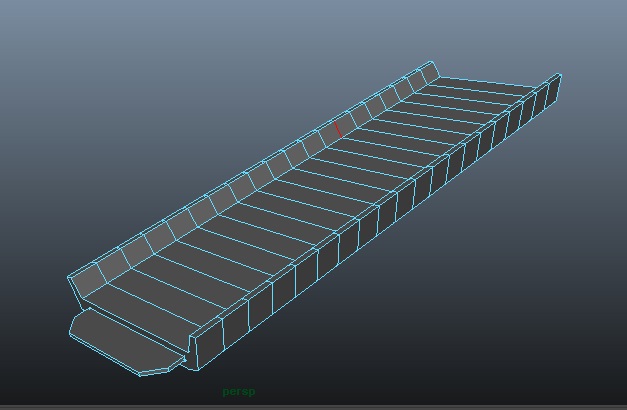
    Extruded Track

    Ends of the track with beveling

    Using Animation to bend/curve the track


    Washboard Modeling


    Creating the glass and extrude the faces for the ribs.

    Beveling of the edges of the ribs.

    Creating the top header, the top panel, and the stringers.

    Creating the legs for the sides of the washboard.

    Reflection
    I found it quite fun to do both the track and the washboard. They were quite simple compared to the previous lab exercises. I managed to follow the instructions accordingly.

    IN3D Week 3 Lab 1 Part 2

    Bucket


    With flaps at the sides

    With holes for the screw

    With screws to connect the handle

    Final bucket with handle

    Reflection
    Although it was quite interesting to do this, I still find it tough. I was having problems with the handle part. I couldn't use the soft modification method because it didn't seem to work for me. And at the beginning, I couldn't get the shape of the bucket probably because I missed out a step or I did not quite understand the instructions. So I decided to ask my friend for help.

    Wine Glass


    Reflection
    I know that we were supposed to design a vase, but some how mine became a wine glass. I don't know why it is like that. Any way, I still love the outcome of my wine glass. :D I changed the transparency settings to make it look a little bit more transparent so that it looks like a glass.